Christian cross
Quo VadisThe Christian cross recurs as a material object and a public sign whose meaning changes the way characters understand suffering and power. It is first encountered in scenes of prayer and remembered sacrifice; later, Peter raises its sign over condemned Christians, while the Roman authorities turn crosses into instruments of execution. In that contrast, the cross stands for a faith that interprets death not as proof of defeat but as testimony to a rule beyond the emperor’s reach.
Form and Early Associations
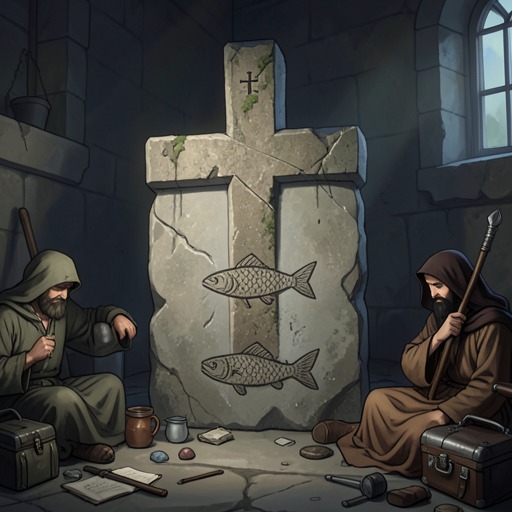
In a hidden meeting place outside the Porta Salaria, Vinicius enters a wine-shed where a small assembly kneels in prayer. Peter is before a wooden cross nailed to the wall, his white hair and raised hands visible in the dim light. The cross belongs to a scene of communal supplication, not public ceremony: the worshippers have lost loved ones and fear the persecution, and their repeated plea for mercy gives the object a setting of grief and shared dependence.
The meaning of the cross is tied to Peter’s recollection of the crucifixion and resurrection. Speaking to the frightened Christians, he remembers seeing Jesus nailed to the cross and dying, and then insists that Jesus rose on the third day. The cross therefore marks suffering, but the story Peter tells refuses to let suffering be the final meaning of the object. Resurrection turns the sign of death into a ground for renewed courage.
Prayer, Doubt, and Vision
Vinicius arrives at the gathering expecting Peter to rescue Lygia and finds instead a community asking where Christ is while evil appears to prevail. He joins the repeated plea for mercy. When the assembly falls silent, he anticipates a miracle; none comes. The lanterns and moonlight remain, the worshippers look toward the cross, and Peter tells them to raise their hearts to the Redeemer and offer their tears. The cross is thus present not as a guarantee that suffering will immediately cease, but as the focus of a faith being tested in the absence of visible deliverance.
Peter answers the crisis by recalling that the first disciples also grieved at the cross before learning that Christ had risen. He urges the congregation to understand their own tears in relation to that sequence: sorrow is real, yet it does not determine the outcome. The cross becomes the hinge between apparent defeat and the conviction that the persecuted can still be victorious.
Peter then opens his arms and looks upward during a vision. He understands that Rome, not Jerusalem, will become the place where Christ establishes his spiritual capital, and that the community’s suffering will form the foundation of the Church. He also takes his commission to feed Christ’s sheep as a command to guide the believers from that place. The cross is therefore joined to Peter’s pastoral authority: it signifies both the cost borne by the community and the religious future he believes will emerge from its witness.
A Sign Raised over the Community
After Peter’s vision, the fearful assembly regains confidence. Some cry Hosanna and others Pro Christo; Peter explains that the Lord has overcome their doubt and blesses them with the cross. The gesture is an act of care as well as a religious sign, binding the group’s renewed resolve to the suffering they expect to face. What had stood on the shed wall now becomes a sign actively bestowed upon the congregation.
The same pattern returns in the arena. As Christians are killed by wild animals, Peter watches unseen from the highest row and blesses them one crowd after another with the sign of the cross. He understands their deaths as testimony to the truth and entrusts them to Christ, recalling that he was commanded to feed the sheep. The sign does not stop their deaths; it gives Peter a way to frame his pastoral duty toward those dying and to affirm their place within the faith community.
The Imperial Reversal
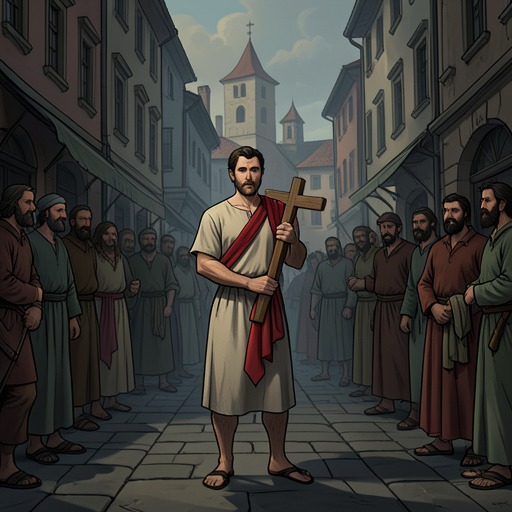
The cross’s most severe reversal comes when Roman officials make it an instrument of execution. Christians who have not been killed in the first day’s spectacle are fastened to crosses in the arena, where they are to be displayed when the games resume. Crispus, who had been ready to die, accepts that he too is assigned to the cross. His presence among the condemned links the object to the believers’ willingness to face death, while the authorities’ use of it makes the conflict between imperial punishment and Christian meaning visible.
Chilo is later brought into the arena and nailed to a low wooden cross. Formerly watchful and hostile, he now appears calm, and the crowd falls silent rather than treating his suffering as entertainment. The scene gives the cross a distinct meaning in his story: it accompanies his final appeal to divine mercy and makes his change of allegiance legible to the spectators. The once-instrumental informer is seen, at the end, as a vulnerable condemned man whom the crowd finds difficult to mock.
Across these scenes, the cross’s physical form remains simple: wood, a wall, a gesture traced in blessing, or a structure in the arena. Its significance shifts with its use. In the prayer meeting it gathers grief; in Peter’s vision it anchors hope and a future community; in the arena it becomes both an emblem bestowed on the condemned and a device imposed by imperial power. That contrast makes the cross a central sign of the novel’s opposition between Roman authority, which can command bodies, and Christian faith, which claims a sovereignty extending beyond death.